
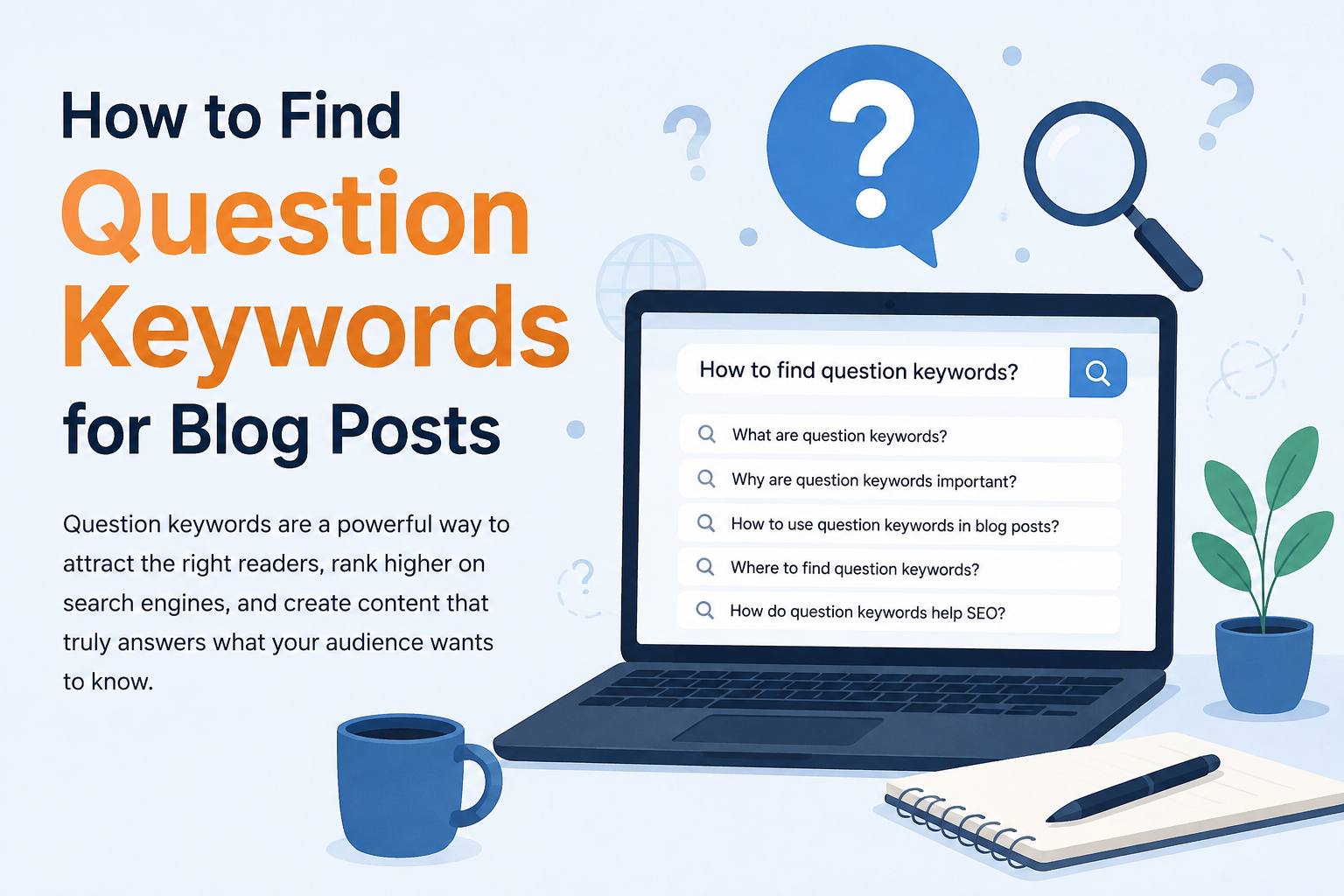
When I started learning about blogging and SEO, I used to think that keyword research was mostly about finding short phrases with a good search volume. Over time, I realized that people do not always search Google by typing simple keywords. Many people type complete questions because they want a specific answer.
This is why I believe question keywords are extremely useful for blog posts. A question keyword can tell me exactly what a reader wants to know. Instead of guessing what my audience is interested in, I can create content around the questions they are already asking.
In this article, I will explain how I find question keywords for blog posts, where I look for them, and how I use them naturally in my content.
What Are Question Keywords?
Question keywords are search phrases that are written as questions. They usually include words such as how, what, why, when, where, which, who, and can.
For example, someone searching for information about blogging might type:
How do I start a blog?
What is keyword research?
Why is SEO important for bloggers?
How many keywords should a blog post target?
Where can I find free keyword research tools?
These searches are valuable because they show a clear purpose. The person is not simply browsing. They usually want an answer to a specific problem.
In my opinion, question keywords are especially useful for beginners because they make it easier to understand what readers actually need.
Why Question Keywords Matter for Blog Posts
I like question keywords because they help me create content that feels useful rather than forced. When I know the exact question a reader is asking, I have a clear direction for my article.
Question keywords can also help with long tail search traffic. A longer search phrase may have fewer searches than a broad keyword, but the person searching it can have a much clearer intention.
For example, the keyword SEO may be extremely broad. Someone searching for how to improve SEO for a new blog has a much more specific goal.
This gives me an opportunity to write an article that directly answers that question.
Question based content can also make blog posts easier to organize. I can use important questions as headings and answer each one in a simple way.
Start With Google Search Suggestions
One of my favorite ways to find question keywords is simply using Google.
I type a broad topic into the search box and look at the suggestions that appear. These suggestions are based on searches people commonly make.
For example, if my topic is blogging, I might type blogging into Google and then try different question words.
I can search:
How blogging
Why blogging
What is blogging
How to start blogging
Why start a blog
Google may show useful suggestions that I can turn into future blog topics.
I do not need an expensive SEO tool for this method. I just need to spend some time exploring different combinations.
Check the People Also Ask Section
Another method I use is the People Also Ask section in Google search results.
When I search for a topic, Google often displays a group of related questions. These questions are excellent sources of content ideas.
For example, if I search for keyword research, I might find questions such as:
What is keyword research?
Why is keyword research important?
How do beginners do keyword research?
What are the best keyword research methods?
Each question could potentially become a section in an article or even a separate blog post.
I also like this method because it helps me discover related questions that I may not have thought about myself.
Use Answer Based Websites
There are many websites where people ask questions and other people provide answers. These websites can be useful for discovering the language that real users use when looking for information.
I pay attention to repeated questions and common problems. If I see many people asking similar questions about a topic, I consider that a strong content idea.
The important thing is not to copy answers from these websites. Instead, I use the questions as inspiration and then create my own original explanation based on my knowledge and research.
Look at Reddit Discussions
Reddit can also be useful for finding question keywords.
People often discuss problems in a very natural way on Reddit. They may ask questions that are different from the phrases used in traditional keyword tools.
For example, instead of searching for a formal keyword such as beginner SEO strategies, someone might ask, How can I get my first blog post to rank on Google?
That question gives me a better understanding of the person’s actual concern.
When I use community discussions for keyword research, I focus on recurring questions and problems. I then create original content that provides a clear and helpful answer.
Explore Forums and Online Communities
Forums, Facebook groups, niche communities, and discussion boards can also provide useful ideas.
I look for questions that appear repeatedly. If people continue asking the same thing, there is probably a need for clear information about that topic.
For example, if I am writing about website security and repeatedly see questions such as How do I protect my website from hackers? or What should I do if my website gets hacked?, those questions can become useful blog topics.
This method is particularly helpful for niche websites because it allows me to understand the problems of a specific audience.
Use Question Keyword Tools
There are also tools specifically designed to discover question keywords.
Some keyword research platforms allow me to enter a broad topic and filter the results by question words. This can quickly produce a large list of possible ideas.
I do not believe that I need to use every available SEO tool. Even free features can provide plenty of useful information if I know how to analyze it.
When using a tool, I look beyond search volume. I also consider relevance, search intent, competition, and whether I can provide a genuinely better answer.
Turn Normal Keywords Into Questions
Another simple technique I use is converting normal keywords into questions.
Suppose my main topic is email marketing.
I can turn it into questions such as:
What is email marketing?
How does email marketing work?
Why is email marketing important?
How can beginners start email marketing?
What are common email marketing mistakes?
When should I send marketing emails?
This technique can quickly transform one broad topic into many content ideas.
Study Your Existing Search Data
If a blog is already receiving visitors, its search data can become a valuable source of question keywords.
I can look at the search queries people use to discover my website. Sometimes visitors find my article through questions that I never intentionally targeted.
Those unexpected queries can give me ideas for future content.
For example, I might have an article about blogging basics, but notice that people are searching for a specific question related to blog writing. I can create a dedicated article that answers that question in greater detail.
This is one of the methods I find most useful because the ideas come from actual visitors.
Think About Your Audience’s Problems
Keyword research should not only be about numbers. I believe understanding the audience is equally important.
Before choosing a question keyword, I ask myself what problem the reader is trying to solve.
If I have a website about blogging, readers may want to know how to get traffic, how to choose keywords, how to write better articles, or how to monetize their websites.
These problems can easily become question keywords.
For me, the best question keywords are usually connected to real problems. When an article solves a genuine problem, it becomes much easier to make the content useful.
Check Search Intent
Finding a question keyword is only the first step. I also need to understand the intent behind it.
For example, the question What is SEO? is probably from someone looking for a basic explanation.
The question How do I improve SEO for my blog? shows that the person wants practical instructions.
The question Which SEO tool should I use? shows that the person may be comparing different options.
These questions may all belong to the same topic, but they require different types of content.
I always try to match my article with the reader’s intention.
Choose Questions That You Can Answer Well
I do not try to target every question I find.
A good question keyword should be relevant to my website and something I can answer properly. If I choose a topic only because it has search traffic, the article may feel weak.
I would rather target a smaller question that fits my audience than write a generic article that does not provide much value.
This approach also helps me build authority around a specific subject over time.
Use Question Keywords Naturally
Once I choose my question keywords, I do not repeat them unnecessarily.
I might use the main question in the title, introduction, or one of the headings. Then I answer it naturally.
For example, if my question keyword is How do I find keywords for blog posts?, I can use that question as a heading and provide a detailed answer underneath it.
I also include related terms naturally throughout the article.
The goal should always be to help the reader first. Search engines are important, but the content still needs to make sense to a real person.
Create FAQ Sections
Question keywords are also excellent for FAQ sections.
At the end of an article, I can answer several related questions that readers may have.
For example, an article about keyword research might include questions such as:
How many keywords should I target?
Can I rank for multiple keywords?
Are long tail keywords useful?
Do I need an expensive keyword tool?
How often should I do keyword research?
This can make the article more complete and useful.
Keep a Question Keyword List
I recommend keeping a simple list of question keywords.
Whenever I find an interesting question, I save it. I can use a spreadsheet, notes application, or even a simple document.
Over time, this list can become a valuable content calendar.
Instead of wondering what to write about every week, I already have a collection of real questions that I can turn into useful articles.
Final Thoughts
Finding question keywords for blog posts does not have to be complicated or expensive. In my experience, some of the best ideas can come from simple places such as Google suggestions, People Also Ask results, online communities, forums, keyword tools, and my own website search data.
The most important thing is to understand what people are trying to learn.
I do not focus only on search volume when choosing a question keyword. I look at relevance, search intent, competition, and whether I can provide a useful answer.
Question keywords can make blog content more focused because they give me a clear problem to solve. They also help me understand my audience better.
If I consistently create helpful articles around genuine questions, I can build a blog that feels useful instead of simply being written for search engines.
For me, that is the real value of question keyword research. It is not just about finding phrases that people type into Google. It is about discovering what people want to know and creating content that gives them a clear, honest, and useful answer.