Writing your first blog post can feel much harder than it actually is. When I started thinking about blogging, one of the biggest problems was not having enough ideas. The real problem was wondering whether my writing was good enough, whether people would read it, and whether I was doing everything correctly.
Over time, I learned that the first blog post does not need to be perfect. It simply needs to be useful, clear, and written for a real person. Your first article is also a learning experience. You will improve your writing, understand your audience better, and become more confident with every post you publish.
In this article, I will explain how I would approach writing a first blog post, from choosing a topic to publishing the finished article.
Choose a Topic You Understand
The first step is choosing a topic that you know something about or genuinely want to learn more about. I would not recommend starting with a subject simply because you think it is popular.
When you understand your topic, writing becomes much easier. You can explain things naturally and share your own opinions and experiences. Readers can also tell when an article feels genuine.
For example, if you enjoy blogging, you could write about choosing a blog topic, creating content ideas, writing headlines, or improving blog traffic.
Try to choose a topic that solves a problem. People often search for information because they want an answer. If your article provides that answer in a simple way, you already have a strong reason for someone to read it.
Know Who You Are Writing For
Before I start writing an article, I like to imagine the person who will read it. This makes the writing feel much more natural.
Ask yourself who needs this information. Is your reader a complete beginner, an experienced professional, a student, a business owner, or someone simply looking for a quick solution?
If your audience is beginners, avoid making the article unnecessarily complicated. Explain important terms and use simple examples.
For example, if you are writing about blogging for beginners, you should not assume that everyone understands terms such as search engine optimization, keywords, hosting, or content management systems.
Your goal should be to make the reader feel that you are helping them instead of trying to impress them.
Create a Simple Outline
One of the biggest mistakes I see new bloggers make is opening the editor and immediately trying to write the entire article.
I prefer creating a simple outline first.
Your outline does not need to be complicated. You can start with the introduction, followed by several main sections, and then finish with a conclusion.
For example, an article about starting a blog could have sections such as choosing a topic, selecting a blogging platform, writing your first article, creating a useful headline, adding images, and publishing the post.
An outline gives your article direction. It also prevents you from repeating the same information.
Write a Strong Title
Your title is one of the first things readers notice. A good title should clearly tell people what they can expect from your article.
Instead of writing something vague like “My Blogging Experience,” you could write “How to Start a Blog With No Experience.”
The second title immediately tells the reader what the article is about.
I believe a good title should be clear before it tries to be clever. If people cannot understand the purpose of your article from the title, they may simply move on.
Start With a Useful Introduction
The introduction should make the reader want to continue.
I like introductions that identify a problem and then explain how the article will help solve it.
For example, if you are writing about writing a first blog post, you could explain that many beginners struggle because they do not know what to write, how to organize their ideas, or how long the article should be.
Then tell the reader that you are going to explain the process step by step.
Try not to make the introduction unnecessarily long. Your reader came for information, so get to the main point relatively quickly.
Write Like You Are Talking to One Person
One thing that helped me improve my writing was imagining that I was explaining the topic to one person.
Instead of trying to sound like a textbook, write naturally.
You can use phrases such as “I believe,” “In my experience,” or “I recommend” when they genuinely reflect your opinion.
This creates a personal tone and helps readers connect with the writer.
You should still keep your information accurate, but there is no need to make every sentence complicated.
Simple writing is often more powerful than complicated writing.
Make Your Paragraphs Easy to Read
Large blocks of text can make an article difficult to read, especially on a mobile phone.
I prefer keeping paragraphs reasonably short and using headings to divide different ideas.
For example, instead of writing one long section about blog titles, introductions, images, and formatting, give each topic its own heading.
This allows readers to scan the article and quickly find the information they need.
Good formatting is not only about appearance. It improves the overall reading experience.
Add Useful Examples
Examples can make almost any article easier to understand.
If you explain a concept, show the reader what it looks like in practice.
For example, if you are explaining blog titles, provide a weak example and then show how you would improve it.
If you are explaining how to create a blog introduction, provide a short sample introduction.
Examples help readers understand your advice instead of simply reading a list of instructions.
Focus on Helping the Reader
When I write an article, I try to ask one important question throughout the process.
What will the reader gain from this?
A blog post should provide some kind of value. It could teach a skill, answer a question, explain a process, share an experience, or help someone make a decision.
Do not add unnecessary information simply to increase the word count.
A shorter article that completely solves a reader’s problem can be more useful than a much longer article filled with repetition.
Use Keywords Naturally
If you want your blog post to appear in search engines, you should understand the basic idea of keywords.
A keyword is a word or phrase people type into a search engine when looking for information.
For example, someone might search for “how to write your first blog post.”
You can naturally include your main topic in the title, introduction, headings, and body of the article.
However, I would never recommend repeating the same keyword excessively. Write for people first and search engines second.
Natural writing usually creates a better experience for readers.
Add a Relevant Image
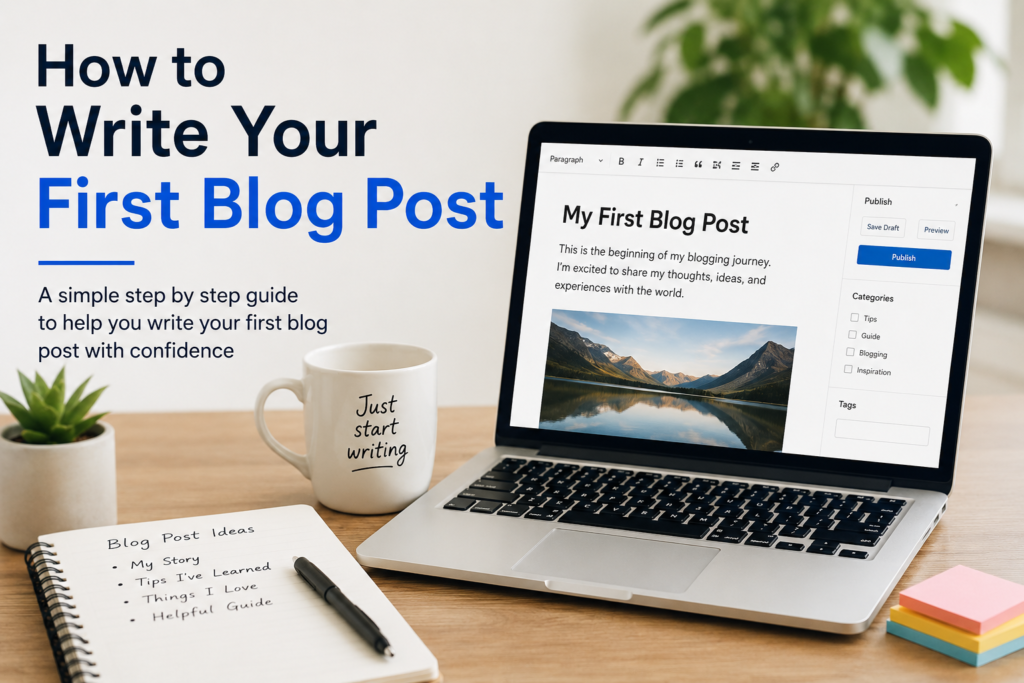
A useful image can make your blog post more attractive and easier to understand.
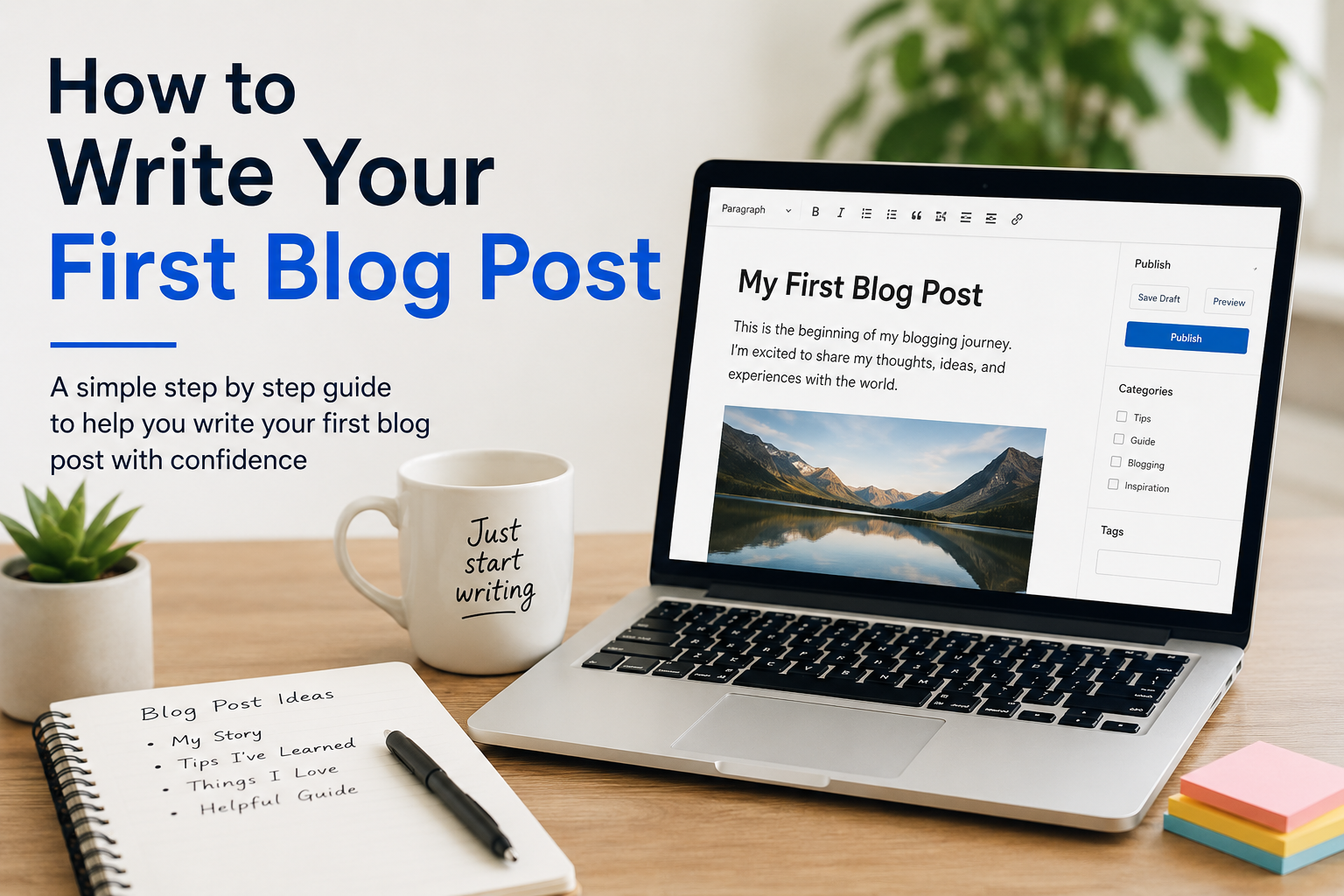
For a beginner blogging article, you could use an image showing a person writing on a laptop, a blog editor, or a simple content planning workspace.
Make sure the image is relevant to the article. Avoid adding random images just to make the page look full.
You should also use descriptive image file names and suitable alternative text when uploading images to WordPress.
Edit Before Publishing
Writing the first draft is only part of the process.
Before publishing, I recommend reading the article from beginning to end.
Look for spelling mistakes, repeated ideas, confusing sentences, and sections that do not add value.
I also recommend checking your headings and making sure the article flows naturally from one section to another.
Reading your article aloud can be surprisingly helpful. Sometimes a sentence looks fine on the screen but sounds awkward when you actually say it.
Do not try to make every sentence perfect. The goal is to make the article clear and useful.
Write a Helpful Conclusion
A conclusion gives you an opportunity to remind readers about the main lesson.
You can briefly summarize what you discussed and encourage the reader to take action.
For a first blog post, you might encourage readers to choose a topic, create an outline, write their first draft, edit it, and publish it.
A good conclusion does not need to repeat the entire article. Keep it simple and useful.
Publish Your First Post
Eventually, you have to stop editing and publish.
This can be the most difficult part for a new blogger because you may continue thinking that the article is not good enough.
I have found that publishing teaches you more than endlessly planning.
Once your article is live, you can see how readers respond. You can learn which topics attract attention and which parts of your content need improvement.
Your first article is not supposed to represent your final level of writing. It represents the beginning of your blogging journey.
Keep Improving After Publishing
Publishing your first article does not mean the learning process ends.
Look at your content after it has been online for some time. Think about what you could improve. You might discover that the title could be clearer, a section needs more explanation, or readers would benefit from additional examples.
Blogging becomes easier when you keep practicing.
Your tenth article will probably be better than your first. Your fiftieth article may be better than your tenth. That improvement happens because you keep writing.
Final Thoughts
Writing your first blog post does not have to be intimidating. The most important thing is to start with a useful topic, understand your audience, organize your ideas, and write in a natural voice.
Do not worry about making your first article perfect. Focus on making it helpful.
Choose a topic you understand, create a simple outline, write an interesting title, explain your ideas clearly, add useful examples, edit your work, and publish it.
From my point of view, the biggest mistake a beginner can make is waiting too long to start. You learn blogging by actually blogging.
Your first post may not be perfect, and that is completely fine. What matters is that you publish it, learn from the experience, and use what you learned to make your next article better.
The sooner you write that first post, the sooner you begin building the skills that can turn blogging from an idea into something real.