
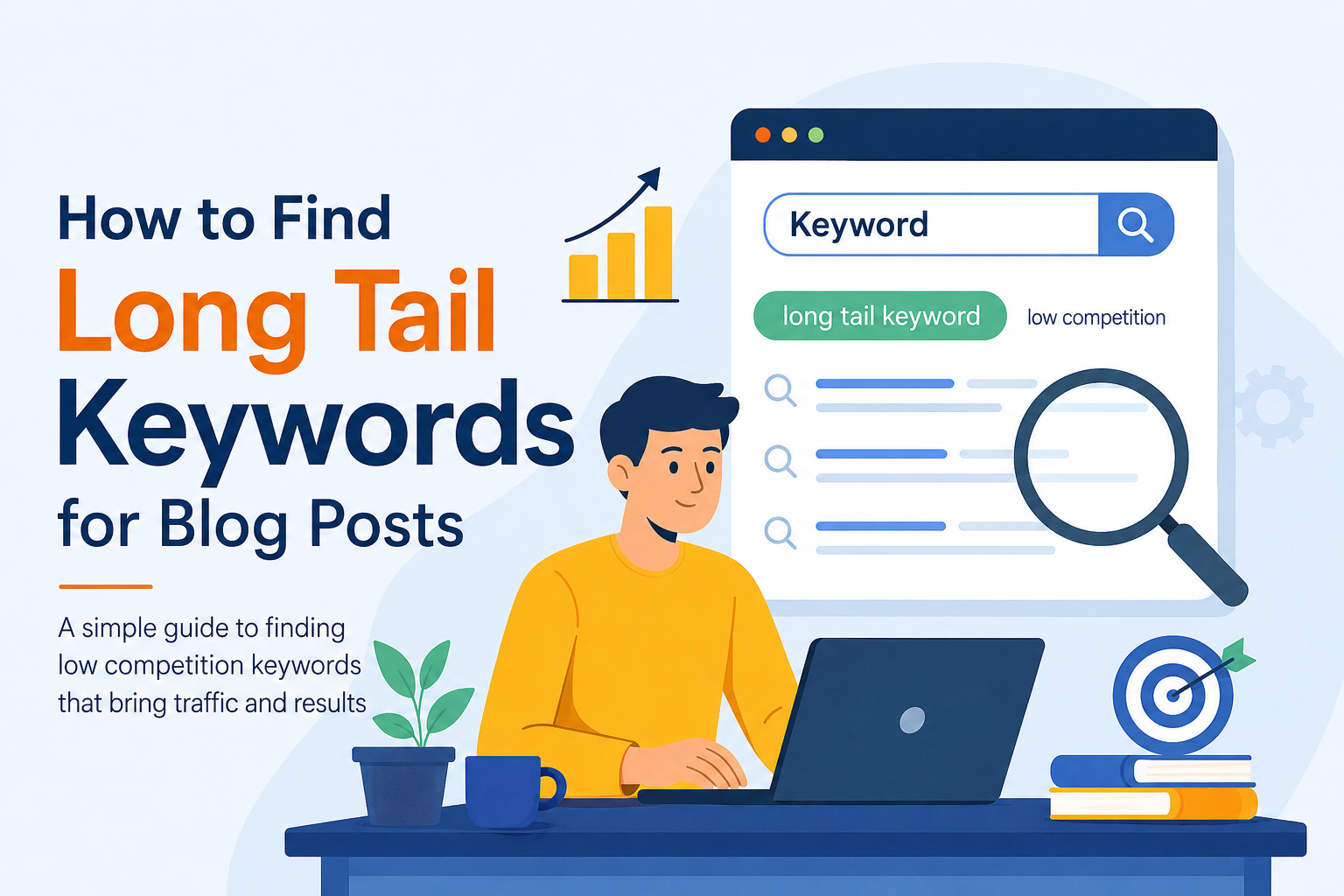
When I started learning about blogging and SEO, I used to think that the best way to get traffic was to target popular keywords with thousands or even millions of searches. At first, this sounded logical. If more people search for a keyword, there should be more visitors, right? But after spending more time learning about search engines, I realized that things are not always that simple.
Popular keywords usually have strong competition. New websites often find it difficult to compete with large websites that already have thousands of backlinks, years of content, and strong domain authority. This is where long tail keywords become extremely useful.
In my opinion, long tail keywords are one of the best starting points for a new blog. They help you target specific searches, understand what people really want, and create content that has a better chance of reaching the right audience.
What Are Long Tail Keywords?
Long tail keywords are longer and more specific search phrases that people type into search engines. Instead of searching for a broad term such as “cybersecurity,” someone might search for “how to protect your home WiFi network from hackers.”
The first keyword is very broad. The second one tells us exactly what the person wants to know.
Long tail keywords can contain three, four, five, or even more words. Their search volume is often lower than broad keywords, but they can be much more targeted.
For example, consider these keywords:
“Blogging”
“How to start a blog”
“How to start a blog for beginners”
“How to start a personal blog with WordPress”
Each phrase becomes more specific as we move down the list.
I personally prefer specific keywords when working on a new blog because they give me a clearer idea of what kind of article I should write.
Why Long Tail Keywords Are Important
The biggest advantage of long tail keywords is that they are usually more focused.
When someone searches for “laptops,” I cannot be completely sure what that person wants. Maybe they want to buy a laptop. Maybe they want laptop repair information. Maybe they want to compare different models.
But if someone searches for “best laptop for graphic design students under 800 dollars,” the search intent is much clearer.
This gives me a better opportunity to create an article that directly answers the person’s question.
Long tail keywords can also be easier for newer websites to target. Instead of competing with huge websites for extremely broad keywords, you can focus on smaller and more specific topics.
Another advantage is that long tail keywords can help you build topical authority. When you publish useful articles covering specific questions within your niche, your website can gradually become more valuable to readers and search engines.
Start With Your Main Topic
The first step I use when finding long tail keywords is to start with a broad topic.
For example, if my blog is about blogging, I might begin with topics such as:
Blogging tips
SEO
WordPress
Content writing
Keyword research
Blog promotion
I would then take one of these broad topics and expand it into smaller questions.
For example, instead of simply targeting “keyword research,” I could look for phrases such as “how to do keyword research for a new blog” or “how to find low competition keywords without expensive tools.”
The goal is to move from a broad idea toward a specific problem.
Use Google Search Suggestions
One of the easiest ways to find long tail keywords is to use Google’s search suggestions.
I simply start typing a topic into Google and look at the suggestions that appear. These suggestions are useful because they represent phrases people commonly search for.
For example, if I type “how to start a blog,” Google may show suggestions related to starting a blog for beginners, starting a blog with WordPress, starting a blog without money, or starting a blog for making money.
I can collect these suggestions and turn them into possible article topics.
Google can also show related searches near the bottom of the search results page. I find these especially useful because they can reveal questions and related topics that I might not have considered.
Look at People Also Ask
Another method I like is checking the People Also Ask section in Google.
These questions can give you excellent ideas for long tail keywords. More importantly, they can help you understand the questions people have around your main topic.
Suppose I want to write about email marketing. I might discover questions such as how email marketing works, how beginners can build an email list, how often emails should be sent, and what makes an email campaign successful.
I can use these questions as separate article ideas or include them as sections inside a larger guide.
Use Keyword Research Tools
There are many keyword research tools available online. Some are free, while others require a subscription.
These tools can provide useful information such as search volume, keyword difficulty, related keywords, and search trends.
I do not think beginners need to spend a lot of money on keyword tools immediately. Free features can be enough to understand the basics and discover many useful keyword ideas.
When I evaluate a keyword, I do not look only at search volume. I also consider competition and search intent.
A keyword with 200 monthly searches may look small, but if those searches come from people who are genuinely interested in the topic, the keyword can be very valuable.
Study Your Competitors
Competitor research is another method I find very helpful.
I search for websites that are already ranking in my niche and study the topics they cover. I look at their article titles, headings, frequently discussed questions, and the smaller topics connected to their main content.
This does not mean copying their articles. Instead, I use competitor research to understand what topics are already attracting attention.
Then I try to find gaps.
Maybe a competitor has written a general article about WordPress security, but they have not explained how beginners can secure a WordPress website step by step.
That gap can become a long tail keyword opportunity.
Focus on Search Intent
Search intent is one of the most important parts of keyword research.
Before choosing a keyword, I ask myself what the person actually wants when they search for it.
Some people want information. Some want to compare products. Some want to buy something. Others want to find a particular website or service.
For example, “what is SEO” has informational intent.
“Best SEO tools for small blogs” has comparison intent.
“Buy SEO software” has commercial or transactional intent.
If I understand the intent behind a keyword, I can create content that matches what the reader expects.
Look for Question Based Keywords
Questions are excellent sources of long tail keywords.
Think about the questions beginners commonly ask in your niche.
If your blog is about cybersecurity, possible questions could include:
How does internet security work?
How can I protect my phone from hackers?
What should I do after clicking a suspicious link?
How can beginners create stronger passwords?
These are specific questions, and each one can potentially become a useful article.
I especially like question based keywords because they make it easier to create helpful titles and organize an article around the reader’s actual problem.
Use Forums and Online Communities
Online communities can also provide keyword ideas.
Forums, discussion websites, social media groups, and question platforms contain real conversations between people. These conversations can reveal problems that people are actively trying to solve.
I pay attention to repeated questions and phrases.
If many people are asking the same question in different ways, that may indicate a useful content opportunity.
The important thing is to use these communities for research rather than copying people’s posts. I take the underlying question and create my own original explanation.
Check Keyword Competition
Finding a long tail keyword is only the beginning. I also want to know whether my website has a realistic chance of competing for it.
I usually search the exact phrase and look at the websites appearing on the first page.
If the results are dominated by extremely powerful websites, ranking may take more time.
However, if I find smaller blogs, outdated articles, forum pages, or content that does not fully answer the question, I see a possible opportunity.
Competition should not be judged by one number alone. The quality and relevance of the existing search results also matter.
Choose Keywords That Match Your Blog
One mistake I see beginners make is choosing keywords simply because they appear easy to rank for.
I believe relevance is more important.
If my blog is about cybersecurity, I should not suddenly target unrelated keywords just because they have low competition.
The keyword should make sense for my audience and fit naturally into my website.
A smaller group of highly relevant visitors can be much more valuable than a large group of visitors who have no interest in the rest of my content.
Create Better Content Around Your Keywords
Once I find a good long tail keyword, I focus on creating the best useful article I can.
I include the keyword naturally in the title, introduction, headings, and relevant parts of the article. However, I avoid repeating it unnecessarily.
Search engines have become much better at understanding topics and context. Because of this, I focus more on answering the reader’s question than trying to insert the same phrase everywhere.
I also try to include examples, practical steps, common mistakes, and related questions.
My goal is simple. When someone finishes reading the article, I want them to feel that their question was actually answered.
Build a Long Tail Keyword List
I recommend keeping a simple spreadsheet or document for keyword ideas.
For each keyword, you can record the keyword phrase, search intent, estimated competition, possible article title, and content status.
Over time, this list can become a complete content plan for your blog.
Instead of wondering what to write every morning, you will already have a collection of specific topics waiting for you.
Final Thoughts
Finding long tail keywords does not have to be complicated. In my experience, the best approach is to start with a broad topic, explore specific questions, study search suggestions, examine competitors, and understand what people actually want.
I would not focus only on search volume. A keyword with fewer searches can still bring valuable visitors if it matches your audience and solves a real problem.
For a new blog, long tail keywords can provide a practical way to build content gradually. You do not need to compete for every huge keyword from the beginning. Instead, you can focus on specific topics, provide genuine value, and build your website one useful article at a time.
That is the approach I would personally follow if I were starting a blog today. I would choose specific keywords that I can realistically target, create genuinely helpful content around them, and keep improving my strategy as my website grows.